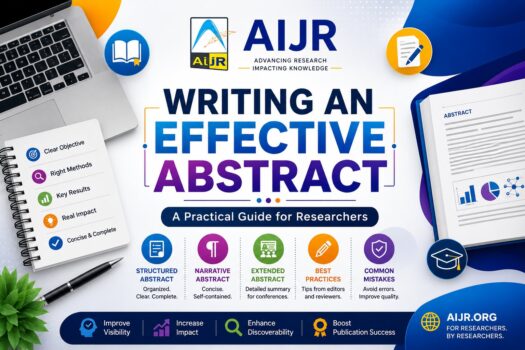
The abstract is often the most widely read section of a research manuscript. Before an editor decides whether a submission fits a journal’s scope, before reviewers examine the full paper, and before researchers decide whether to read an article, they typically read the abstract. A well-written abstract helps readers quickly understand what was studied, why it was studied, how the research was conducted, what was found, and why the findings are important. A poorly written abstract can obscure the value of good research and reduce the likelihood that the work will be read, cited, or accepted for publication.
If you are unsure where to begin, remember that an effective abstract should answer five essential questions:
- What problem or topic does the study address?
- What is the objective of the research?
- How was the study conducted?
- What are the main findings?
- Why do those findings matter?
Regardless of discipline, research design, or publication type, most successful abstracts answer these questions clearly and concisely.
Types of Abstracts
Academic journals, conferences, and institutions generally require one of three abstract formats: a structured abstract, an unstructured abstract, or an extended abstract. Understanding the differences can help researchers prepare abstracts that meet submission requirements and reader expectations.
Structured Abstract
A structured abstract presents information under predefined headings. The exact headings may vary among journals, but commonly include:
- Background
- Objective
- Methods
- Results
- Conclusion
Example of a Structured Abstract
Background: Digital learning technologies are increasingly used in higher education, yet their influence on student engagement remains uncertain.
Objective: This study examined the relationship between online learning practices and student engagement among undergraduate students.
Methods: Survey data were collected from 420 students enrolled in online courses across five universities. The data were analyzed using regression analysis.
Results: Students who participated in interactive learning activities reported significantly higher engagement levels than those exposed primarily to lecture-based instruction.
Conclusion: The findings suggest that interactive teaching approaches can improve student engagement in online learning environments.
Advantages of a Structured Abstract
- Easy for readers to scan.
- Ensures essential information is included.
- Facilitates editorial and peer review.
- Commonly required in medical, healthcare, and scientific journals.
Unstructured Abstract (Narrative Abstract)
An unstructured abstract, also known as a narrative abstract, presents the entire summary as a single paragraph without subheadings. Although headings are absent, the abstract should still contain the study’s background, objective, methodology, key findings, and conclusion.
Example of an Unstructured Abstract
Digital learning technologies have transformed educational practices in higher education institutions. This study investigated the relationship between online learning practices and student engagement among undergraduate students enrolled in online courses across five universities. Data were collected from 420 students and analyzed using regression analysis. The findings indicated that students participating in interactive learning activities reported significantly higher engagement levels than those primarily exposed to lecture-based instruction. These results suggest that interactive teaching strategies may improve student engagement and learning outcomes in online learning environments.
Advantages of an Unstructured Abstract
- Suitable for strict word limits.
- Common in management, engineering, social sciences, and humanities.
- Allows concise presentation of information.
Many journals require narrative abstracts because they provide a complete summary in a compact format.
Extended Abstract
An extended abstract is a more detailed summary of a research study than a traditional journal abstract. Unlike standard abstracts that typically range from 150 to 300 words, extended abstracts often range from 500 to 2,000 words depending on conference requirements.
Extended abstracts are most commonly used for:
- Conference submissions
- Conference presentations
- Symposiums
- Workshops
- Research forums
- Doctoral consortiums
An extended abstract may include:
- Introduction
- Research objectives
- Methodology
- Key findings
- Discussion
- Tables or figures
- References
Because the structure and purpose of an extended abstract differ substantially from those of a journal abstract, we discuss this topic separately in our guide.
Read next: How to Write an Extended Abstract
Comparison of Abstract Types
| Feature | Structured Abstract | Unstructured Abstract | Extended Abstract |
|---|---|---|---|
| Format | Headings | Single paragraph | Multiple sections |
| Typical Length | 150-300 words | 150-300 words | 500-2,000+ words |
| Common Use | Journal articles | Journal articles | Conferences |
| Includes Methods and Results | Yes | Yes | Yes, in greater detail |
| Includes References | No | No | Yes |
| Includes Tables or Figures | No | No | Sometimes |
What Should an Abstract Include?
Regardless of format, an effective abstract should contain five key elements.
1. Background or Context
Begin by briefly introducing the topic or problem that motivated the research. The background should provide enough context for readers to understand the importance of the study without turning into a literature review.
Example
“Supply chain disruptions have increased interest in resilient procurement strategies among manufacturing organizations.”
2. Research Objective
Clearly state what the study aimed to investigate, evaluate, compare, or explore.
Example
“This study examined the impact of supplier diversification on supply chain resilience in manufacturing firms.”
Readers should immediately understand the purpose of the research.
3. Methods
Briefly describe how the research was conducted. Depending on the study, this may include:
- Research design
- Data source
- Sample size
- Experimental procedures
- Statistical methods
- Analytical techniques
Example
“Data collected from 315 manufacturing firms were analyzed using structural equation modeling.”
Only include information necessary to understand the research approach.
4. Key Results
The results section is often the most important part of an abstract. Readers want to know what was discovered.
Weak statement: “The results are discussed.”
Stronger statement: “The analysis revealed that supplier diversification significantly improved resilience during periods of supply chain disruption.”
Whenever possible, report specific findings rather than general statements.
5. Conclusion and Relevance
Conclude by explaining why the findings matter. The final sentence should communicate the contribution of the study and its practical, theoretical, or policy implications.
Example
“The findings suggest that supplier diversification can strengthen organizational resilience and reduce operational risks.”
The Formula Behind Most Effective Abstracts
Most successful abstracts follow a simple sequence:
Context → Objective → Methods → Results → Relevance
This structure mirrors the questions readers naturally ask when evaluating research.
- Why was the study needed?
- What was investigated?
- How was it investigated?
- What was found?
- Why is it important?
If these questions are answered clearly, the abstract is likely to communicate the study effectively.
How to Write an Unstructured Abstract
Many journals require a narrative abstract presented as a single paragraph. In such cases, the abstract should provide a concise but complete summary of the manuscript. A useful guideline is:
The abstract should provide an accurate summary of the manuscript including the aims, methods, key results, and relevance of the study within the prescribed word limit in a single paragraph without citations or subheadings.
A practical approach is to write:
- One sentence describing the context.
- One sentence stating the objective.
- One or two sentences describing the methodology.
- Two or three sentences summarizing the findings.
- One concluding sentence explaining significance.
What Should Not Be Included in an Abstract?
A strong abstract is not only defined by what it contains but also by what it excludes.
References and Citations
Abstracts should not contain references, citations, footnotes, or bibliographic information. The abstract must be self-contained and understandable without requiring readers to consult other sources. Avoid statements such as:
“Previous studies by Smith (2022) demonstrated…”
or
“Several researchers have reported similar findings [12,13].”
Readers should be able to understand the study without referring to the reference list.
References to Tables, Figures, or Sections
Do not refer readers to other parts of the manuscript. Avoid statements such as:
- “Results are shown in Table 2.”
- “Figure 3 illustrates the findings.”
- “Details are discussed in Section 4.”
The abstract should stand on its own and summarize the essential information directly.
Excessive Abbreviations
Avoid excessive use of abbreviations and acronyms. Many readers encounter the abstract before reading the full manuscript and may not be familiar with specialized terminology.
For example, writing:
“The SEM results indicated that TQM positively affected SCM performance.”
is less accessible than:
“Structural equation modeling results indicated that total quality management positively affected supply chain management performance.”
If an abbreviation must be used because it is widely recognized or repeatedly appears in the abstract, define it upon first use.
Detailed Literature Review
The abstract is not the place to summarize previous studies in detail. Limit the background to the information necessary to establish context.
Unsupported Claims
Avoid exaggerated statements and conclusions that are not supported by the reported findings. The conclusion should reflect the actual results of the study.
Common Mistakes That Weaken Abstracts
Many abstracts are rejected or require revision because of avoidable errors. Common problems include:
- Failing to state a clear objective.
- Providing too much background information.
- Omitting key results.
- Reporting vague findings.
- Using excessive technical jargon.
- Including undefined abbreviations.
- Adding citations or references.
- Exceeding the word limit.
- Presenting conclusions that are not supported by the results.
Identifying and correcting these issues can significantly improve the quality of an abstract.
Abstract Writing Checklist
Before submitting your manuscript, review the following checklist.
✓ Does the abstract clearly explain the research problem?
✓ Is the objective explicitly stated?
✓ Are the methods briefly described?
✓ Are the key findings reported?
✓ Is the significance of the findings explained?
✓ Does the abstract accurately reflect the manuscript?
✓ Is the abstract free of citations and references?
✓ Is the abstract free of unnecessary abbreviations?
✓ Can the abstract be understood without reading the full paper?
✓ Does it comply with the required word limit and format?
If the answer to any of these questions is no, further revision may improve the abstract.
Final Thoughts
The abstract is often the first opportunity to communicate the value of your research. A strong abstract helps editors, reviewers, and readers quickly understand the purpose, methods, findings, and significance of a study. Successful researchers understand that an abstract is more than a summary. It is a gateway to the entire study. By mastering the process of writing an effective abstract, authors can clearly communicate their objectives, methods, findings, and contributions, increasing the likelihood that their research will be read, understood, and cited by the wider scholarly community. Whether preparing a structured abstract, a narrative abstract, or an extended abstract for a conference submission, the goal remains the same: provide a clear, accurate, and concise summary of the research. Researchers who invest time in writing effective abstracts improve the visibility, accessibility, and overall impact of their scholarly work.